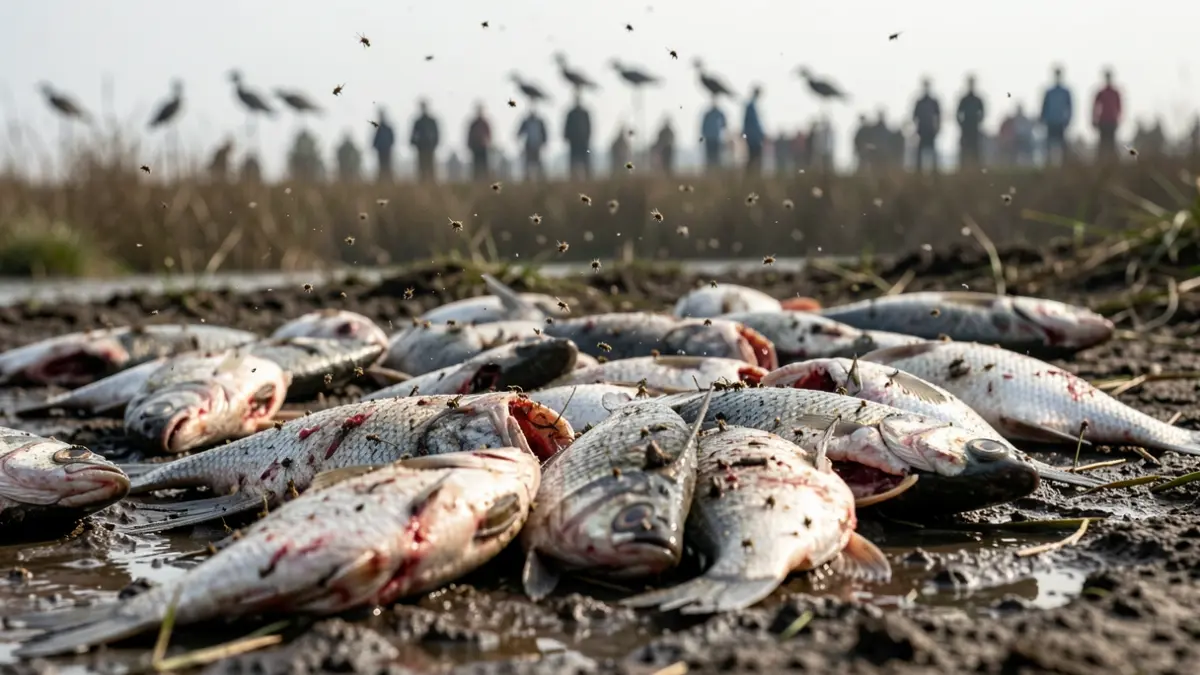
The research, published in the journal Freshwater Biology, was conducted in the El Hondo Natural Park (Alicante) and shows that the energy from dead fish does not reach terrestrial vertebrates solely through direct consumption of carcasses. A significant portion is transferred via invertebrates that colonize the bodies and are subsequently consumed by birds and other vertebrates.
The article jointly analyzes the vertebrate and invertebrate communities associated with large accumulations of dead fish and their changes throughout the decomposition process. The study was carried out within the framework of common carp (Cyprinus carpio) die-offs occurring in El Hondo during management actions for this invasive species. Mass mortality events, caused by droughts, extreme temperatures, or lack of oxygen, are becoming increasingly relevant in the context of global change.
The work monitored 20 carp accumulations, with an average biomass of approximately 110 kilograms per accumulation, over 35 days. Camera traps were used to record vertebrate activity, and invertebrate samples were taken. 35 vertebrate taxa and 20 invertebrate groups were identified.
One of the main results is that 60% of the vertebrate taxa fed exclusively on invertebrates associated with the carcasses, while only 11.4% consumed the dead fish directly. Another 28.6% combined both feeding types. Among the invertebrate consumers, numerous small insectivorous passerines, other birds, and some mammals were notable. The carp carcasses were colonized by over 200,000 individuals, primarily dipteran and dermestid larvae.
The importance of different consumers changes as the carcasses decompose. Vertebrates that directly ate fish were more abundant in the early stages, while those feeding on invertebrates increased over time, coinciding with changes in the invertebrate community.
“"The results show that a large accumulation of dead fish is not simply a resource for scavengers. These carcasses generate an associated invertebrate community that, in turn, becomes food for other vertebrates."
In this way, invertebrates act as intermediaries between aquatic and terrestrial ecosystems, facilitating the transfer of energy from dead fish to terrestrial animals. Large fish die-offs function as hotspots of trophic activity in wetlands. Understanding these large biomass pulses is key to knowing their consequences on biodiversity and ecosystem functioning, especially given the increase in mass mortality events associated with global change.