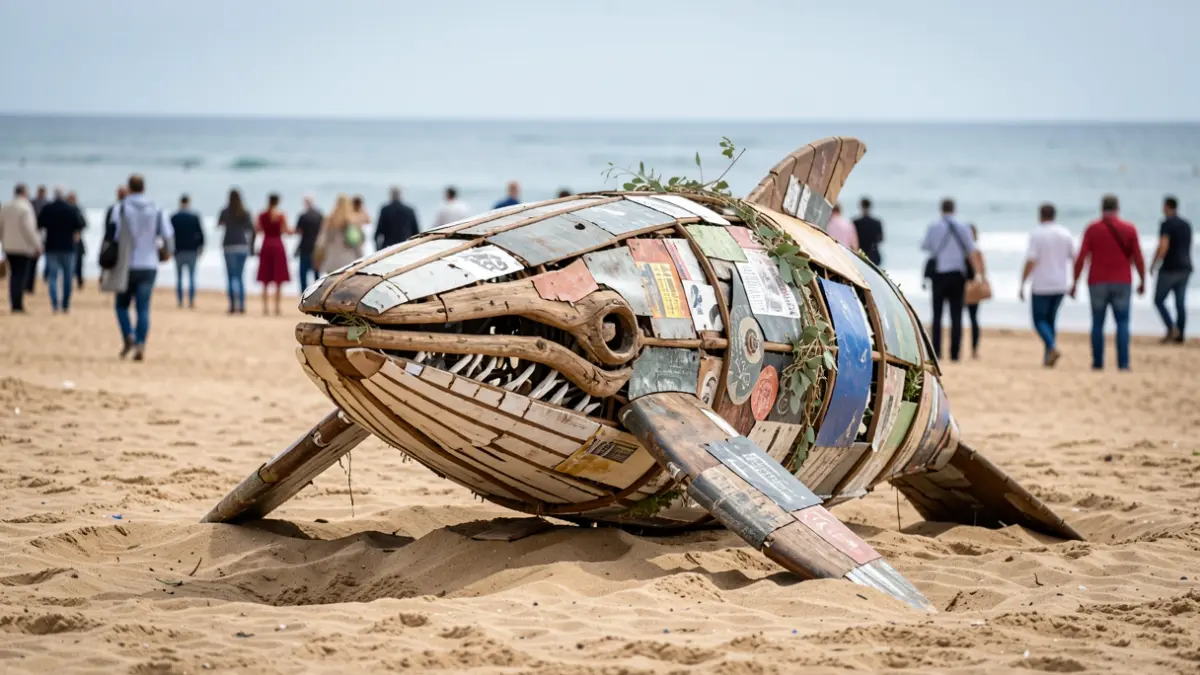
This imposing sculpture, named 'Romalda', is not a real stranded animal but a conceptual and eco-built work of art driven by the collective Ciudad Feliz. Its aim is to raise awareness about sustainability and social justice, using the skull of a fin whale, the largest animal in the Mediterranean, as its base, complemented by eucalyptus and recycled materials that denounce plastic consumption.
Conceived by artist Rafa Gallent, 'Romalda' is described as a project of hope and commitment. Its presence at the festival, thanks to collaboration with the Fundación Exodus, makes it a symbol of transformative culture, connecting the local sphere with global projection.
“"Romalda is not just art; it is a project of hope understood as the long view after effort and commitment."
The whale not only attracts attention visually but also carries profound messages. It includes 'messages in a bottle' written by patients from the Psychiatry unit of the Hospital Provincial de Castellón, seeking empowerment and visibility for a healthier society. The project also integrates artistic proposals on the complexity of hatred and war, and an integrated wheelchair symbolizes collaboration with groups with reduced mobility.
In collaboration with Greenpeace, 'Romalda' also advocates for the conservation of cetaceans. One of its 'vertebrae', made of melted plastics, symbolically represents the waste generated by supermarkets in just one hour. The project, developed with the Cátedra de Arquitectura Circular of the Universitat Jaume I (UJI), upholds the principle of returning to nature everything that is taken from it.
Despite receiving a National Award for Intergenerationality and attracting international interest, Ciudad Feliz maintains its local essence. Management falls to Maite Rivera, who highlights the importance of funding and political will for projects that contribute to changing the world. The initiative invites participation in workshops, reflection on the 'common good', and joining beach clean-up and reforestation actions.
In line with preservation, Gurugú beach will host environmental actions during the festival. The Asociación Econsciencia will set up a tent for the care of the Mediterranean coastline, promoting the collection of cigarette butts and microplastics under the campaign '#elmarempiezaenmí / #elmarempiezaenti', encouraging small gestures to leave the beach in better condition.