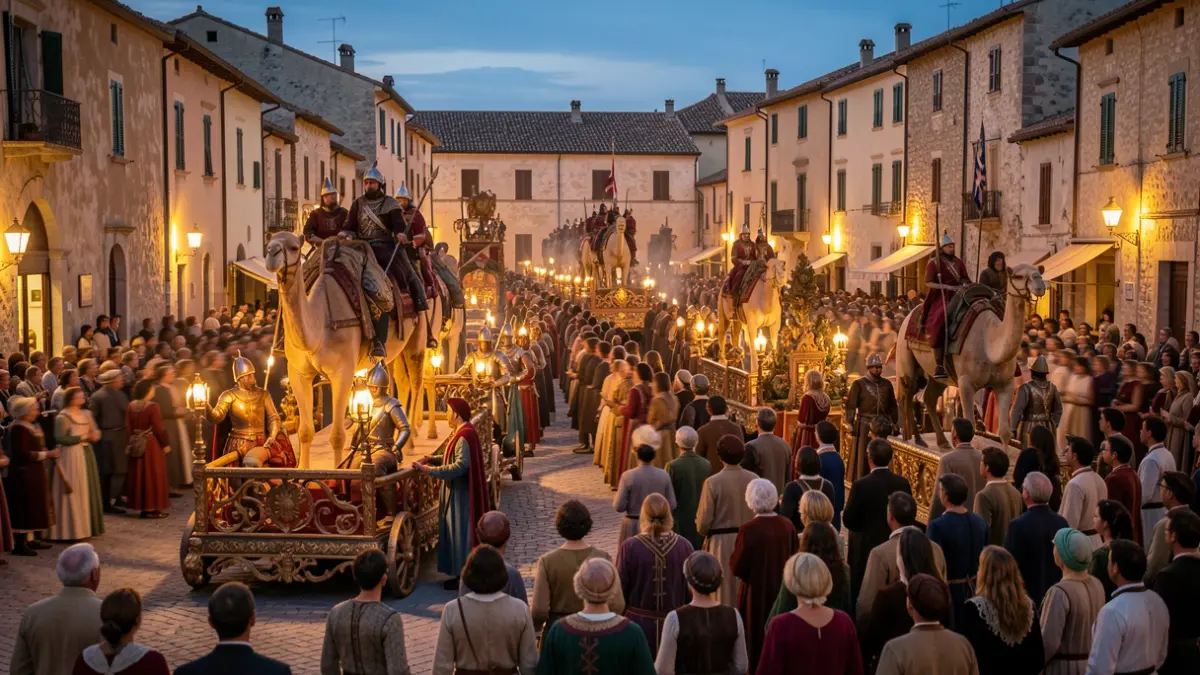
The city of Ontinyent experienced a spectacular night yesterday with the Moorish Entry, where the Moros Marinos comparsa, led by captain Juan Luis Galiana Aleixandre, recreated the feat of Mehmed II, who conquered Constantinople in 1453. The parade transported the history of the Ottoman city to the Vall d'Albaida, becoming the central theme of an event marked by a grand spectacle.
The crescent moon's side paraded through the city's main arteries in the second major parade of the Moorish and Christian festivals. The Moros Marinos' proposal focused on the sea and started from a historical license: the conquest of Constantinople, which changed the course of Europe. In the designed narrative, the Ottoman conqueror then set his sights on a new objective: Ontinyent.
The spectacle began with the frigate Almanzor, a symbol of the Moros Marinos. After overcoming the chains that blocked maritime access, the dance by Masters Ballet represented the battle between the city's resistance and the force of the vessels. The Dardanelos and Mitja Lluna squads symbolized the combatants and the ghazis, preparing for the landing on dry land.
The parade continued with units inspired by the Ottoman military organization, such as the sipahis and Janissaries, and infantry riflemen. Cannons and bombards evoked the siege of Constantinople, symbolically transferring the offensive to the walls of Ontinyent. Female warriors from Anatolia and Rumelia, archers, and noble soldiers represented the fall of the defenses.
The second phase of the spectacle showcased the grandeur of the Ottoman court. Camels, Mamluks, and African mercenaries gave way to a caravan representing the empire. The Ballet Ópera introduced the court with a Turkish-inspired dance, followed by a performance of wishes and omens for the sultan, and the representation of the imperial palace with a female escort on horseback.
The culminating moment arrived with Juan Luis Galiana Aleixandre, the Moorish captain, symbolically representing Mehmed II. He appeared at the head of a retinue with representatives of great families, accompanied by the Ontinyent Symphonic Band and a grand chariot pulled by four Friesian horses. Twelve flags of the court families reinforced the image of the city's definitive possession.
Following the captain, the Moros Marinos themselves arrived, led by their traditional Gastadors. The parade continued with the other eleven comparsas of the crescent moon's side: Chanos, Omeyas, Benimerins, Abencerrajes, Kábilas, Saudites, Mudéjares, Mossàrabs, Taifas, and Moros Berberiscos.
The Moros Españoles comparsa closed the parade with a Moorish Embassy set in the year 1086, recreating the union of the taifa kingdoms of Al-Andalus to face a common threat. The spectacle was structured into blocks dedicated to the Abbadids of Seville, the Umayyads of Valencia, and the Albaicín kingdom of Granada.
Nobles, warriors, and banners shaped each territory before converging in a council representing the union of the different kingdoms to form a great coalition. The final block featured the Asdiqa, leading the alliance, followed by the Moorish ambassador, Sergi Garcia, and the standard-bearer, David Mateu, with music from the Unión Musical de Ontinyent.
The Embassy concluded with an epilogue by the Moros Españoles, delivering a final message of unity: great victories belong to those who walk together under a common cause, a particularly relevant motto in times of polarization.