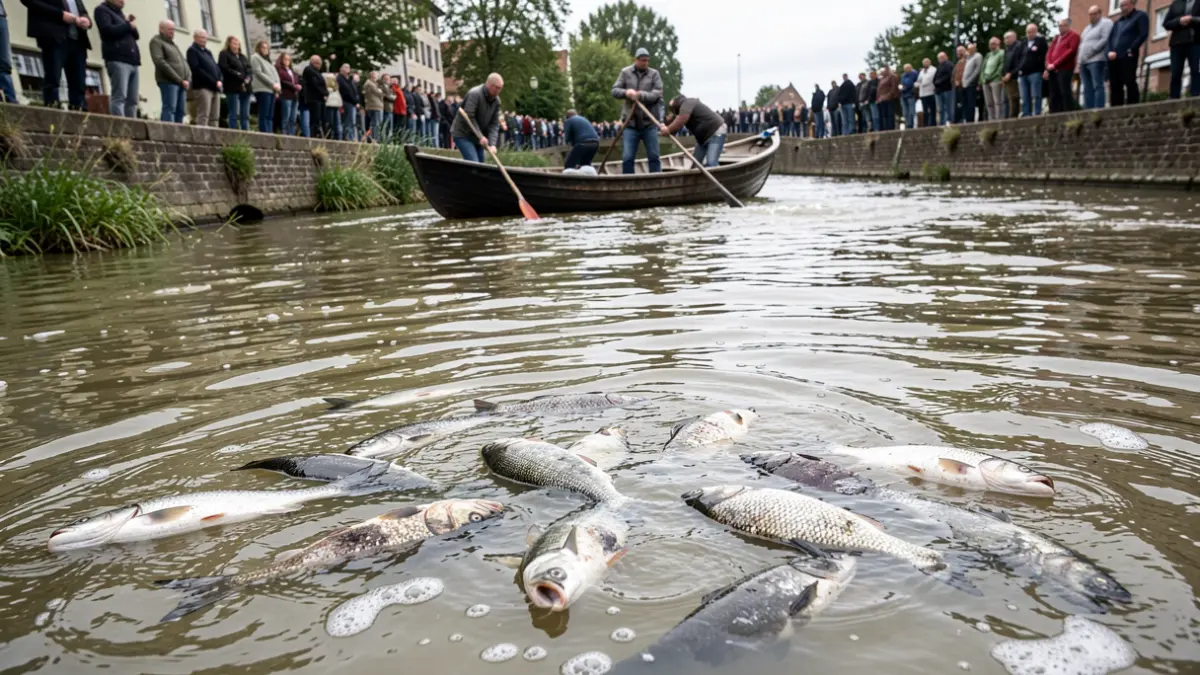
The Júcar Hydrographic Confederation (CHJ) initiated a massive removal of dead fish from the River Magro this Monday. Operations are concentrated on an approximately ten-kilometer stretch running through the municipalities of Montroy and Llombai-Alfarp. The primary hypothesis regarding the cause of this mass mortality points to a potential spill originating from the industrial estate in Montserrat, where a warehouse fire occurred last week.
The public company Tragsa is carrying out the extraction of the dead animals, as confirmed by CHJ sources. The tasks are being performed both from the water and from land to collect the largest possible number of specimens. A boat is being used to locate and gather fish floating or trapped in the riverbed. Concurrently, three teams, each comprising two individuals, are working from the banks to manually remove animals appearing along the affected stretch.
The CHJ cannot yet provide an approximate figure for the dead fish, as the operations present considerable complexity due to the length of the affected section (nearly ten kilometers) and areas with difficult access to the river's course. The projection is that the work will extend for several days, possibly until the end of this week, depending on the operation's progress and the number of specimens still being found.
Once removed from the river, the fish are managed as waste. They are stored appropriately and subsequently transported to a specialized facility in Almassora, Castellón province, for final treatment.
Regarding the causes of the mortality, one of the CHJ's main lines of investigation focuses on a spill related to the warehouse fire at the Montserrat industrial estate last week. The hypothesis is that contaminants present in the facilities mixed with the water used for firefighting, causing runoff that reached the River Magro, where foam was detected.
The fire broke out on the night of Thursday, September 10th, in a warehouse belonging to a company producing hygiene chemical products, and later spread to an adjacent wood production company's warehouse. The fire was reported under control by early Friday morning.
The CHJ's Water Quality Area is investigating the events to determine the causes of the contamination. Based on technical results, necessary measures will be decided, including the possibility of initiating sanctioning proceedings if any violation of current environmental regulations is detected, to assign responsibility for the impact on the river and its fish fauna.