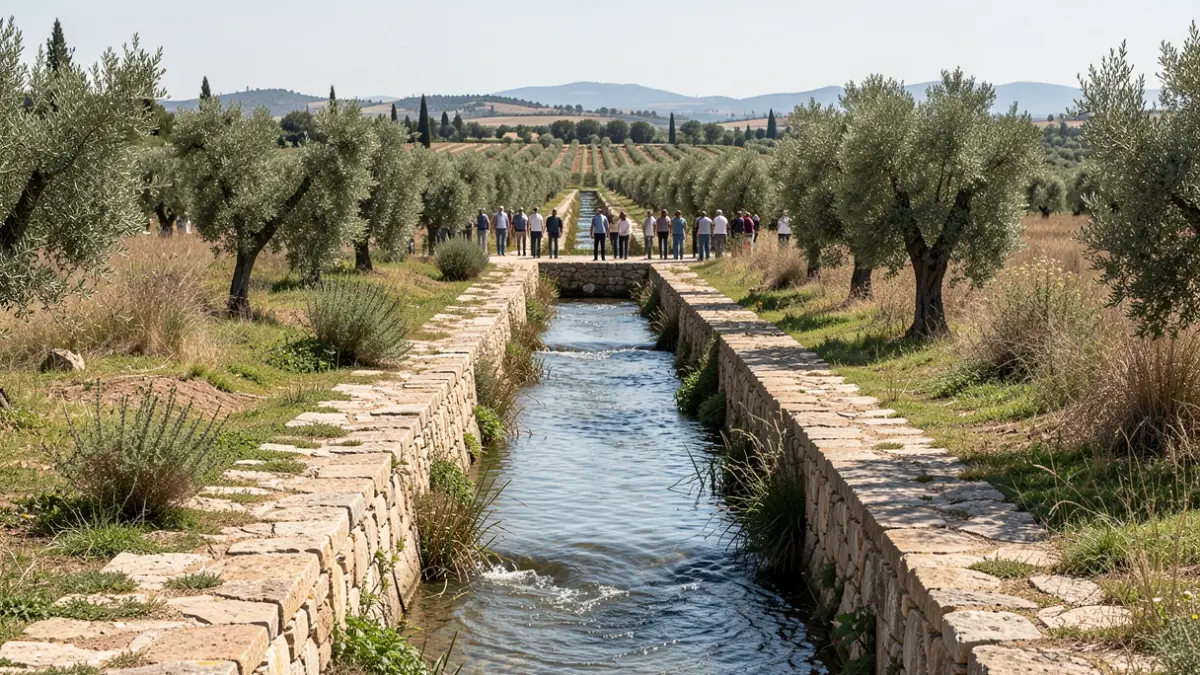
The Common Canal of Énova, a 13th-century Andalusian hydraulic infrastructure, remains vital for irrigating over 21,300 'hanegadas' in the Ribera Alta region. This canal, originating from a weir on the Albaida River, near its confluence with the Xúquer River, creates an irrigation system resulting from human action on an alluvial fan. The radial design of the ditch system testifies to the existence of this fan, formed by fertile sediments from the Xúquer.
The irrigated area, known as the Pla de Énova, covers lands in Manuel, L’Énova, Rafelguaraf, Pobla Llarga, Sant Joannet d’Énova, Senyera, and Castelló de la Ribera. It drains into the Barxeta and la Cubella ravines. According to historian Tomás Peris Albentosa, this infrastructure is key to the irrigation of the Ribera Alta and is part of the valuable Valencian hydraulic heritage, serving as an economic and cultural engine alongside other major canals.
The House of the Commune of the Canal of Énova, located in l’Énova, has been the historical headquarters for irrigators since the 19th century. It serves administrative functions and houses a valuable historical archive with community management documents dating from the 17th to the 20th centuries. Although the exact construction date of the main canal is unknown, it existed before 1325, as evidenced by a rescript from King James II of Aragon. The current regulations date from 1846, modifying those from 1671.
The water distribution system is based on medieval turns. Castelló de la Ribera constantly receives one-third of the available water. The remaining flow is divided into the “sobirana or upper turn”, which begins on the Monday following June 24th, and the “susana or lower turn”. The former corresponds to the Canal de la Parada (Manuel), while the latter belongs to the Royal Distributor of the Commune.
The Weir of Énova marks the starting point of the Common Canal. The canal runs along the right bank of the Albaida River, crossing the La Costera region to enter La Ribera. Several main canals branch off from it: the Canal de Parada (15th century), the Canal del Terç de Castelló with its branches, the Canal de les Foies (Manuel and Sant Joan), the Main Canal of Énova with the Partidor de la Comuna, and the Major Canal of La Pobla Llarga.