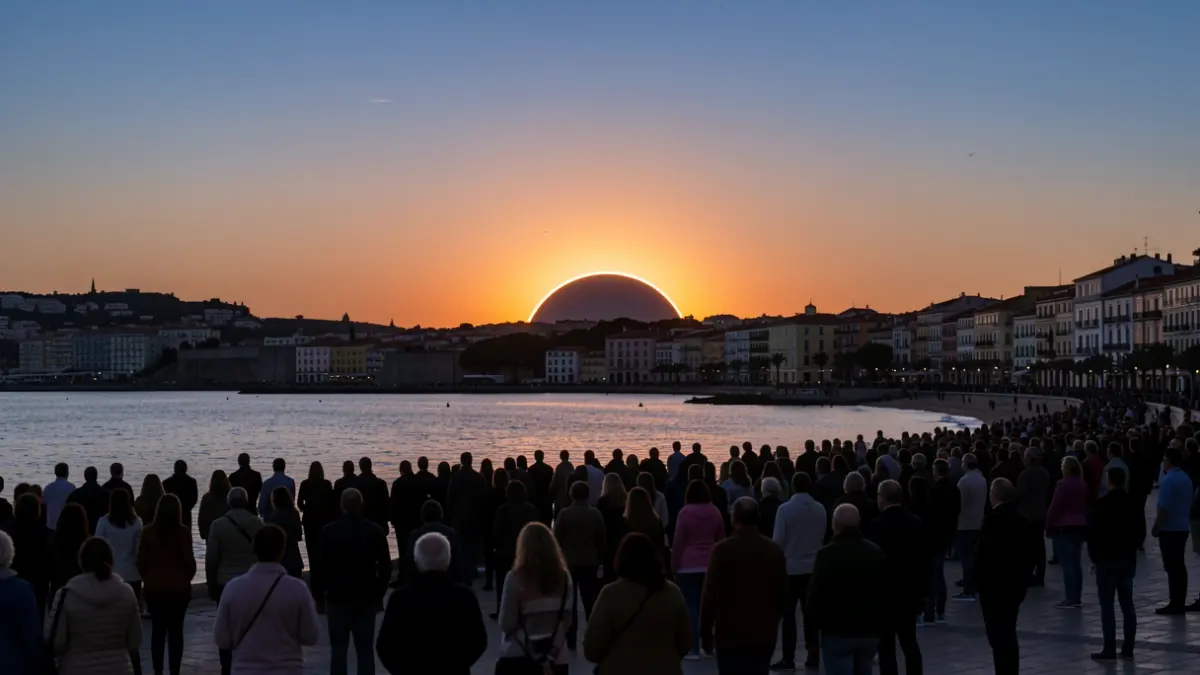
The mayor of Castelló, Begoña Carrasco, has reviewed the total solar eclipse experienced on August 12th, calling it a "historic day" where over 80,000 people enjoyed the event from the city's beaches. Carrasco emphasized that the massive presence of citizens and international tourists not only allowed for witnessing "a unique and unforgettable experience" but also served to promote the city and its beaches, "putting Castelló on the map".
The Castelló City Council organized a "varied program" for the day, including the installation of the Sol and Luna stages, workshops, and the participation of a dozen renowned scientific communicators, such as Javier Santaolalla and Josep Calatayud, combining leisure, culture, and tourism.
During the event, six information points set up along the coastline assisted 3,542 people, 57% of whom came from outside the province. Visitors from over a hundred Spanish municipalities and 36 countries were recorded. 16.4% of visitors were foreign, with France, Italy, the United Kingdom, and Poland having the highest representation, followed by the United States, Romania, Germany, among others. Nationally, visitors from the Community of Madrid and Catalonia stood out.
The Councilor for Tourism, Arantxa Miralles, highlighted that the data demonstrates Castelló's potential as a tourist destination, making it an international meeting point for extraordinary events.
The tourism impact resulted in "technical full occupancy" in hotels, with an average occupancy of 97% and an average price of 180-185 euros per night, according to data from the hotel association Hosbec. Many reservations had been made up to two years in advance. The mayor noted that full hotels "directly benefit the economic dynamism of Castelló," with more bookings in restaurants and shops.
Regarding cleaning, the service was reinforced with an extraordinary operation that increased container capacity by 30,000 liters, managing 197,380 kg of waste, 10% more than on Sant Joan's Night. The operation included 57 teams for manual cleaning, beaches, and coastal areas, as well as specialized vehicles.
The online broadcast of lectures and talks by scientific communicators from Castelló was the most watched in Spanish worldwide via YouTube, with over 340,000 internet users connected, reaching peaks of 25,000 people simultaneously. Additionally, traditional media, including television channels from the UK and France, conducted live broadcasts from the city.
The day proceeded with "total normality" and a "festive" atmosphere, with few health incidents despite the historic turnout. The mayor praised the "civility, responsibility, and foresight" of the attendees, which facilitated the work of the security and emergency services, comprising over 300 personnel.