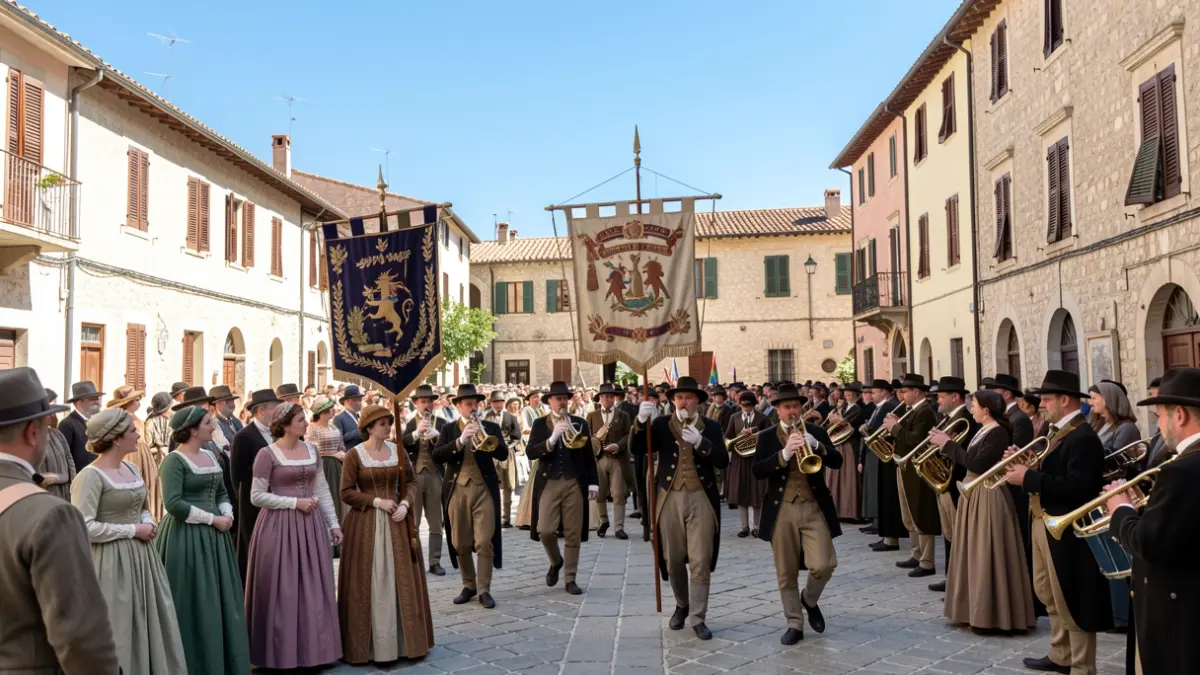
The Requena Fair will host this year the traditional civic procession to commemorate the so-called Action of September 13, 1836, the date on which the city managed to repel a Carlist attack commanded by generals Gómez Damas and Cabrera. This celebration, held for years, starts from the City Hall and winds through emblematic streets such as Pedro Sosa, Carmen, Plaza de España, Peso, Plaza del Portal, and García Montés, ascending to the historic old town via the Cuesta del Cristo to the Plaza del coronel Albornoz, where a commemorative plaque is located.
At this site, the mayor, after a speech, will lay a laurel wreath on the plaque, while the municipal band plays the Spanish national anthem. The Cuesta del Cristo is considered a key point of Requena's defense during that historic day.
The action of September 13, 1836, is part of the First Carlist War (1833-1840), a period marked by Carlist incursions involving looting and extortion in the region. Requena stood as a liberal and Isabelino bastion, resisting constant attacks and sieges, even sheltering residents from other towns like Utiel and Venta del Moro.
As early as 1835, Requena had taken fortification measures due to the proximity of Carlist factions. On September 18 of that year, an attack by the Carlist general Ramón Cabrera, nicknamed 'The Tiger of the Maestrazgo,' who had previously taken Utiel, was repelled.
During the first half of 1836, Carlist pressure intensified. In Requena, the Governing and Defense Board was established, and companies of the National Guard Battalion were formed. On August 14, 1836, the City Council proclaimed the Constitution of 1812.
On September 7, 1836, Carlist general Gómez arrived in Utiel with a large expedition. On September 12, a meeting was held in Utiel with the presence of Cabrera and Gómez, along with other leaders such as Quílez, Serrador, or Miguel Sancho, where the decision was made to attack Requena.
The siege of Requena involved a Carlist numerical superiority over the 900 defenders. Faced with Colonel Ruiz de Albornoz's refusal to surrender, Gómez decided to abandon the siege.
The 'Action of Requena' had significant national repercussions. On September 21, 1836, Isabella II granted Requena the title of 'Muy Noble y Muy Leal Ciudad' (Very Noble and Very Loyal City) and a liberal coat of arms. Colonel Albornoz received the Laureled Cross of Saint Ferdinand.
A municipal agreement on October 10, 1836, established September 13 as a public holiday. The procession, interrupted during the latter half of the 20th century, was revived in 1995.
The 1872 petition, submitted by 26 residents, requested the expansion of the celebration with festivities involving running bulls and heifers in the squares of Arrabal and Portal, recalling the city's heroism against the Carlist 'faction'.