Valencia's Gran Vía Marqués del Túria now features new sound-absorbing pavement designed to reduce traffic noise and improve road safety. This prominent avenue has seen 22,126 square meters of roadway resurfaced with an investment of 1.24 million euros. The company Pavasal carried out the work, concentrated on the section between Jacinto Benavente avenue and the intersection of Regne de València avenue with Russafa street.
The Mayor of Valencia, Mª José Catalá, accompanied by the Councilor for Urban Planning, Juan Giner, visited the completed works this Thursday. Catalá highlighted the importance of this intervention on one of the busiest routes, emphasizing that the new pavement provides "more safety, reduces the acoustic impact of traffic, and makes Gran Vía a more comfortable and livable space." She assured that "these types of urban solutions are here to stay".
This project is part of a broader municipal plan to minimize acoustic impact in the city. The mayor announced that over 130,000 square meters of sound-absorbing pavement are being installed in various ongoing works, which will result in an annual saving of approximately 500 tons of CO2. For instance, Colón street will incorporate 12,000 m2 of this material as part of its renovation, scheduled for Christmas.
Other road axes included in this strategy are Pérez Galdós-Giorgeta, Corts Valencianes avenue, General Avilés in Campanar, and the PAI of Malilla Sud. Catalá recalled that the reopening of Pérez Galdós and Giorgeta after summer will alleviate traffic on main routes, and that the redevelopment of San Agustín square will also commence.
Regarding traffic management, the mayor announced plans to restrict motorcycle parking on the sidewalks of major avenues like Marqués del Túria or Colón to facilitate pedestrian flow, and the creation of one hundred new parking spaces in the central reservations.
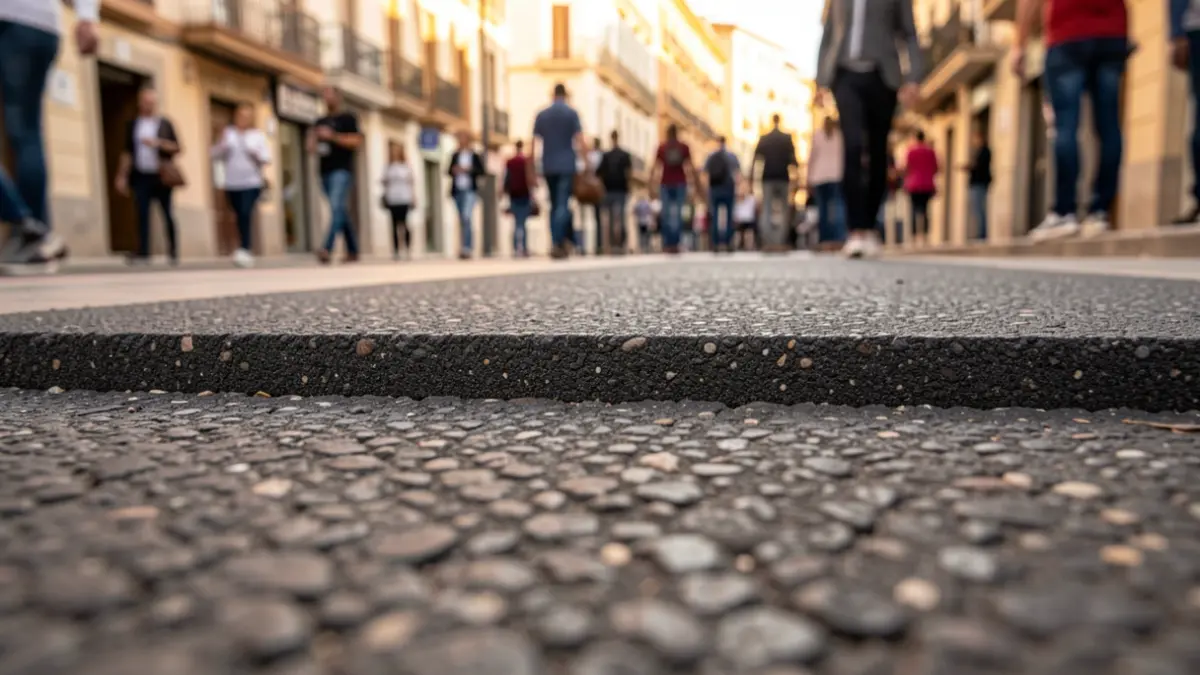
The comprehensive renovation of Marqués del Túria, including prior upgrades to the sanitation network (with an investment exceeding 646,000 euros), has a total cost of over 1.8 million euros. The new pavement has not only eliminated defects like cracks and subsidence but also improves grip and safety. The sound-absorbing asphalt, which can reduce noise by up to ten decibels and CO2 emissions by up to 20%, has been applied to the roadway, except for the bus lane, where conventional asphalt was chosen for technical reasons related to durability and acoustic performance against heavy bus traffic.
The work also involved renovating gutters, drains, and drainage systems to prevent water accumulation. The execution was organized in phases and primarily conducted at night to minimize disruptions to traffic and residents.