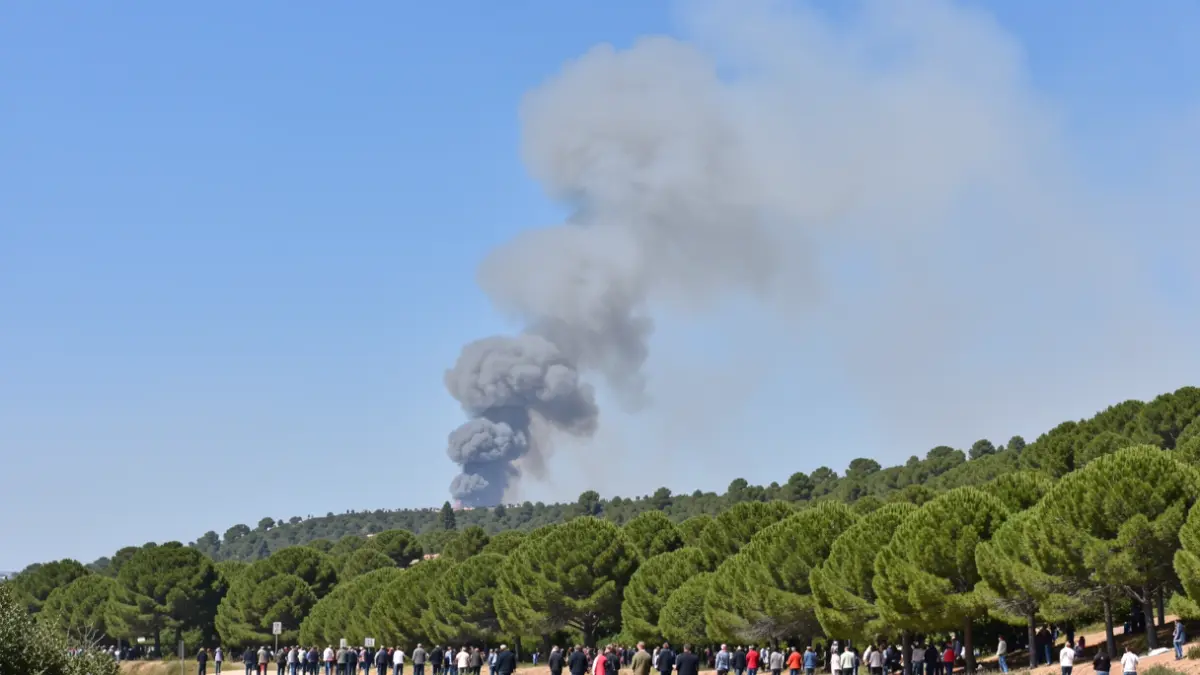
The risk of forest fires in the Valencian Community does not end with the canicule, the period traditionally associated with the highest temperatures. Historical data compiled by the Generalitat Valenciana shows that, since August 15, over 50,000 hectares have been burned in the 21st century. Specifically, 53,100 hectares in the last 26 years, representing 37% of the total over 141,000 hectares scorched during the summer campaigns.
One of the most severe examples of fires occurring after the August bank holiday is the Bejís fire in 2022, which started on August 15 due to a latent lightning strike and ended up consuming 19,500 hectares. This was the most serious fire recorded from that date onwards, far exceeding others like the one in Vall d'Ebo, which also surpassed 10,000 hectares and was initiated by an electrical storm.
Although the extent of fires after August 15 has generally been smaller, cases like Montitxelvo (2,077 hectares burned in November) or the fires in La Solana in 2010 (over a thousand hectares) highlight how climate change can des-seasonalize fire periods. That year, 5,400 hectares burned from August 15 onwards.
Historically, the percentage of land scorched after August 15 has been significant. In the year 2000, 4,978 hectares of the total 6,154 were burned, with notable fires in Planes (623) and Xàbia (372). In 2001, it was 3,599 hectares out of a total of 4,569, and in 2007, 5,700 hectares from the second half of August.
So far this summer, the fires in Vall d'Uixó (nearly 9,500 hectares, including 12% of the Serra d'Espadà) and Tírig (800 hectares) have been the most alarming. With temperatures still high, tourist and festive activities, and the possibility of storms, the fire campaign is not considered over, as evidenced by constant warnings from 112.