
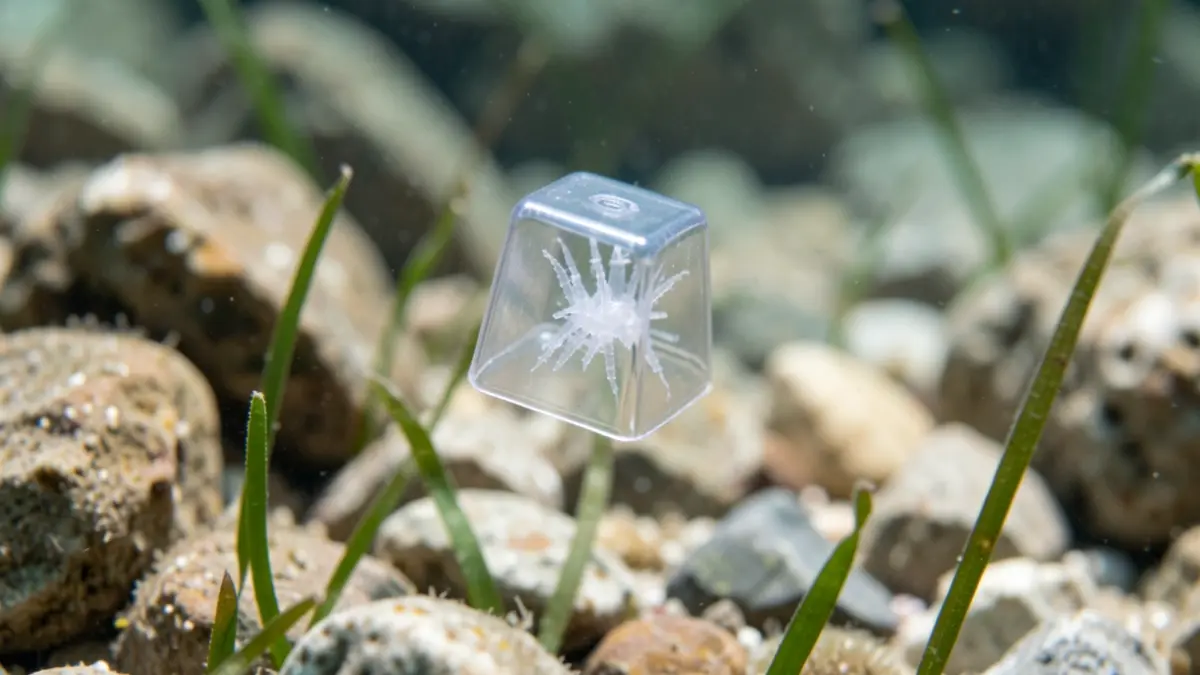
The discovery, made by the UA Marine Lab in Dénia, is part of a joint campaign with the Oceanogràfic that collected over 200 specimens. This finding represents the second cubomedusa species recorded in the Mediterranean, alongside Carybdea marsupialis described by Linnaeus in 1758, highlighting the undiscovered biodiversity in well-studied seas.
Copula lucentia, measuring between one and seven millimeters, was identified through morphological and genetic studies. Its scientific description, published in the journal Marine Biodiversity, was made possible by collaboration with international specialists. Eva Fonfría, a researcher at the University of Alicante and lead author of the study, explained that the discovery occurred during a sampling campaign, noting morphological characteristics that did not align with known species.
The scientific name, Copula lucentia, refers to Lucentum, the Latin name for Alicante. So far, its presence has only been documented in El Campello, making this area of interest for further study. Fonfría emphasizes the importance of continuing to study these organisms to understand their distribution and role in marine ecosystems.
This jellyfish belongs to the cubozoa group, characterized by a cubic bell shape and a transparent body. The studied specimens were found less than a meter and a half deep, in rocky, sandy bottoms and seagrass meadows. Comparison with the species Copula sivickisi, along with genetic analyses, confirmed it as a new species.
César Bordehore, professor in the Department of Ecology at the University of Alicante and coordinator of the UA Marine Lab, considers the discovery a "milestone" for marine research, demonstrating that much remains to be known about the Mediterranean's biodiversity. He highlights the need to expand research on small marine organisms, which can significantly interact with fisheries production.
The Sea4Future project, led by Bordehore with collaboration from the Oceanogràfic, aims to restore fisheries production in the Mediterranean while protecting vulnerable species. A new sampling campaign with the Oceanogràfic has located over 200 specimens for continued study. Some are being maintained and exhibited at the Medusa Lab of the Oceanogràfic to study their controlled reproduction.
Miguel Candelas, biologist and head of Jellyfish at the Oceanogràfic, notes that maintaining this species in an aquarium for the first time is a challenge, which will enhance knowledge of its biological needs. The collaboration between the University of Alicante and the Oceanogràfic combines expertise in marine ecology, taxonomy, and genetics with experience in maintaining gelatinous organisms.
Specimens of Copula lucentia can be observed at the MedusaLab of the Oceanogràfic of Valencia through a magnifying glass, allowing their characteristics to be distinguished. The official registration is in the World Register of Marine Species.