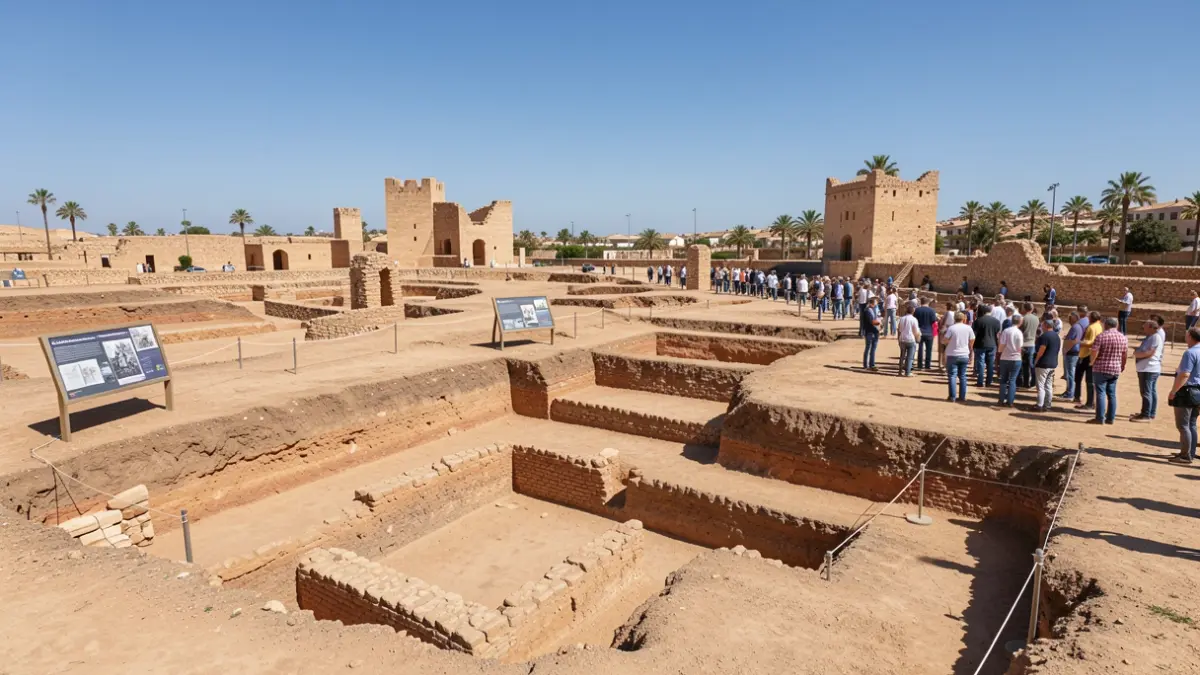
The musealization displays the results of nearly a decade of excavations through signage, panels, stratigraphic restitutions, and educational resources. The rector of the University of Alicante, Amparo Navarro, highlighted the collaboration of the Elche City Council in this initiative, defined as "a magnificent example of institutional cooperation around the knowledge and valorization of our heritage".
Navarro emphasized the exceptional nature of the findings, which for the first time offer a comprehensive sequence of the different historical stages documented in this sector of the site. "There is an idea that summarizes its philosophy very well: research to know, know to conserve, and conserve to explain," she stated, underscoring the importance of returning the accumulated knowledge to society and facilitating the understanding of archaeological remains.
The intervention, which transforms the scientific results of Domus into a cultural resource, is not limited to preserving the structures but provides the keys to interpreting the successive forms of occupation of the space. Sonia Gutiérrez, professor of Archaeology at the UA and director of the project along with professors Julia Sarabia, Jesús Moratalla, and Victoria Amorós, advocated for this dimension of archaeological research: "because that's what our work is about: thinking with our hands, delving into the substance of the material record".
The comprehensive consolidation and musealization project includes signage, an explanatory circuit, stratigraphic restitutions, temporal axes, panels, and didactic material. These resources allow for contextualizing the preserved structures and offering a coherent reading of a space where traces from very different eras coexist.
The project Domus-La Alcudia. Vivir en Ilici, launched in 2017, focused on sector 4F of the site, documenting one of the most extensive stratigraphic sequences. The methodology involved advancing from the most recent levels towards the oldest, reconstructing the site's history in reverse.
The result is an occupation sequence dating from the 4th century BCE to the contemporary period, reconstructing the different landscapes this space has acquired: Iberian settlement, Roman city, Andalusian rural area, among others. The musealization now allows this succession of landscapes to cease being information reserved for specialists and be directly interpretable on site.
The research will continue with the publication of scientific and didactic works, as well as new lines of study and the implementation of a GIS documentation system. Among the upcoming objectives is the restudy of the northeastern front of La Alcudia in light of the data obtained by Domus.