
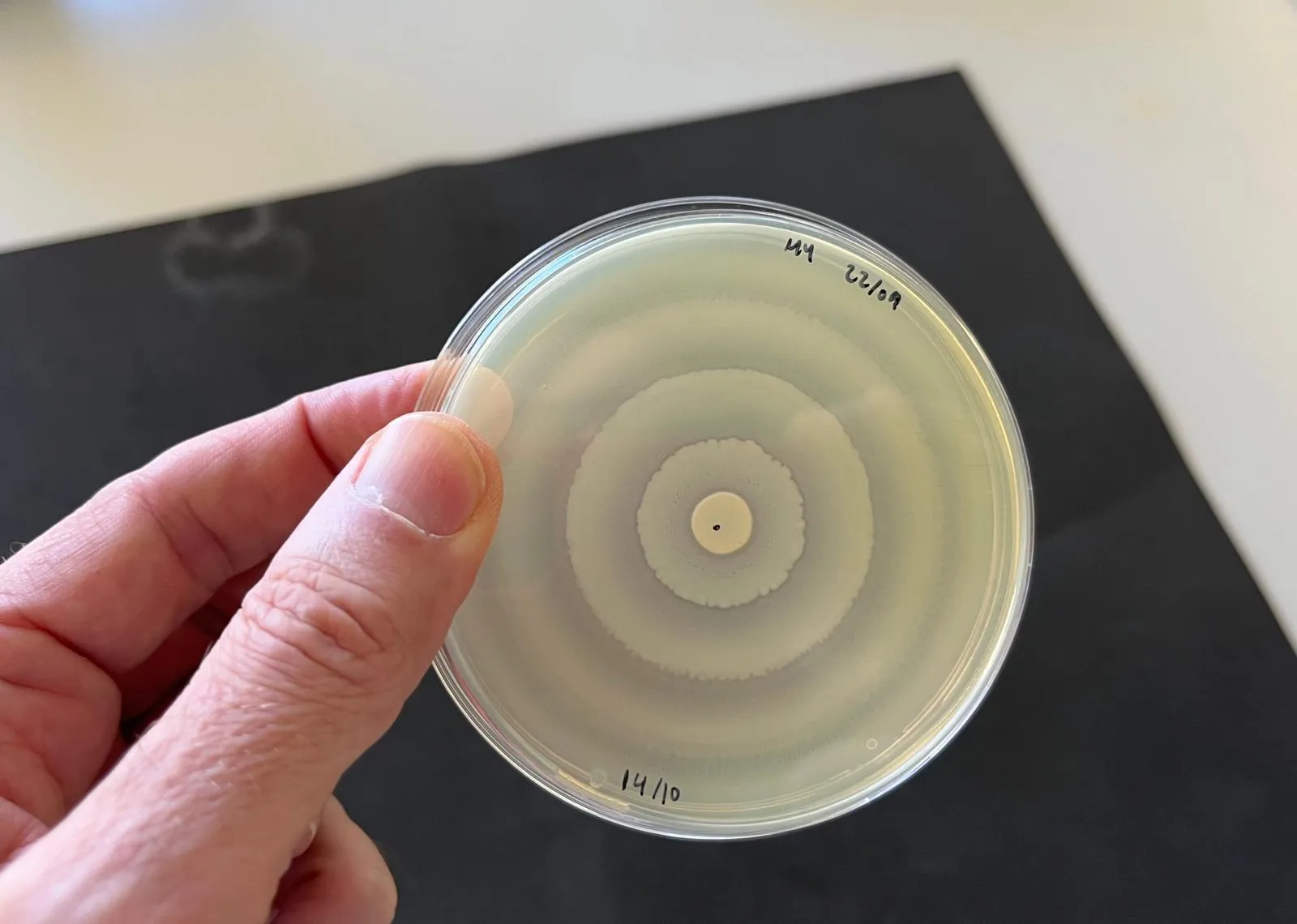
The publication, shared by Manuel Porcar, a researcher at the institute and CTO of Darwin Bioprospecting Excellence, has surpassed 5,000 'likes' and 200 comments on LinkedIn, achieving over 300,000 impressions and gaining 500 new followers for Porcar in just two days. The image shows the growth of a bacterium isolated from the intestine of a mackerel, collected by David de los Reyes, a student in the Biotechnology and Synthetic Biology group at I2SysBio.
The phenomenon, known as swarming, allows certain microorganisms to move rapidly and in a coordinated manner. Although documented, the regularity of the rings observed in the petri dish has surprised the research team. Manuel Porcar explains it's a combination of factors such as quorum sensing (information exchange between bacteria) and the diffusion of compounds on the culture surface, in addition to the existence of two differentiated cell forms: a small, poorly mobile one, and a gregarious, elongated one, which moves very quickly in a coordinated way.
The team does not yet have a clear explanation for the precision of the rings and is working on characterizing the microorganism, which has not yet been identified, to study its growth patterns and explore potential biotechnological applications. Porcar suggests this behavior might allow it to rapidly colonize the digestive tract of the fish it inhabits.
The virality of the publication, according to Porcar, is due not only to the microorganism's uniqueness but also to the way science is communicated. He emphasizes the importance of starting with a suggestive opening sentence, combining scientific rigor with understandable metaphors, using eye-catching images, and leaving open questions to encourage participation, such as how bacteria manage to stop their movement to draw near-perfect circles.
In addition to leading the research group, Manuel Porcar is the Chief Technology Officer (CTO) and co-founder of Darwin Bioprospecting Excellence, a biotechnology company specializing in the search and characterization of microorganisms with potential applications in various sectors. The study of microbial diversity opens new avenues for scientific knowledge and biotechnological development.