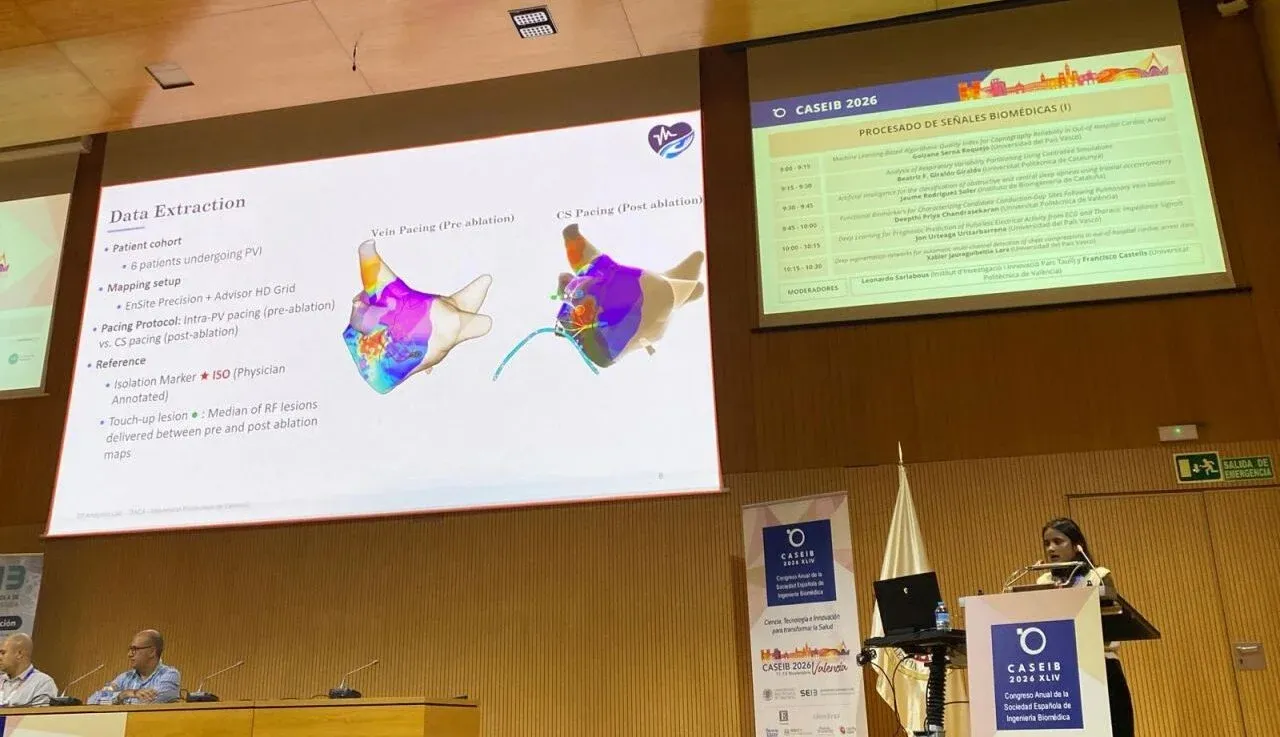
Under the theme “Science, Technology and Innovation to Transform Health”, the event brought together researchers, healthcare professionals, and industry representatives to present the latest advances in biomedical engineering, exchange knowledge, and promote new opportunities for collaboration and technology transfer.
ITACA contributed at least nine scientific presentations covering areas such as cardiac electrophysiology, artificial intelligence, biomedical signal processing, digital twins, and clinical monitoring, highlighting the breadth of its research and its applications in healthcare.
A significant proportion of the research presented focused on developing new tools to improve the diagnosis and treatment of arrhythmias through artificial intelligence, signal processing, and computational simulation. Researchers including Deepthi Priya Chandrasekaran, Alonso del Pozo Tobajas, Pablo Santamaría Manzano, Alejandro López Lamata, Rafael Ortega López-Sánchez, and Elisa Ramírez Candela presented work on characterizing electrical abnormalities, detecting ventricular fibrosis, generating ventricular re-entry datasets, predicting epicardial signals, and digitizing electrocardiograms.
The COR (Cardiac Oriented Research) group also presented studies on non-invasive cardiac diagnosis and the development of personalized digital twins. Gemma Lucas Salido demonstrated how a volumetric approach can locate septal atrial ectopic beats, while Raquel Monllor explained the reconstruction of ventricular electrical activation using only surface torso signals, marking a step towards patient-specific cardiac digital twins.
In the field of clinical monitoring, Juan Navarro Sevilla, a researcher at the La Fe Health Research Institute, presented a study conducted with Antonio Martínez Millana, Deputy Director of ITACA, and Esther del Arco Fuster (UPV), comparing non-invasive optical signals with invasive arterial recordings in intensive care patients, seeking to establish the potential of these technologies for blood pressure monitoring.
Beyond the presentations, ITACA researchers including Vicente Traver, Francisco Castells, José Millet, and María Guillem played an active role in the scientific program, chairing sessions and contributing as experts to various discussions. ITACA’s broad representation at CASEIB 2026 highlights its research capabilities and its commitment to developing technologies that improve people’s health and quality of life.