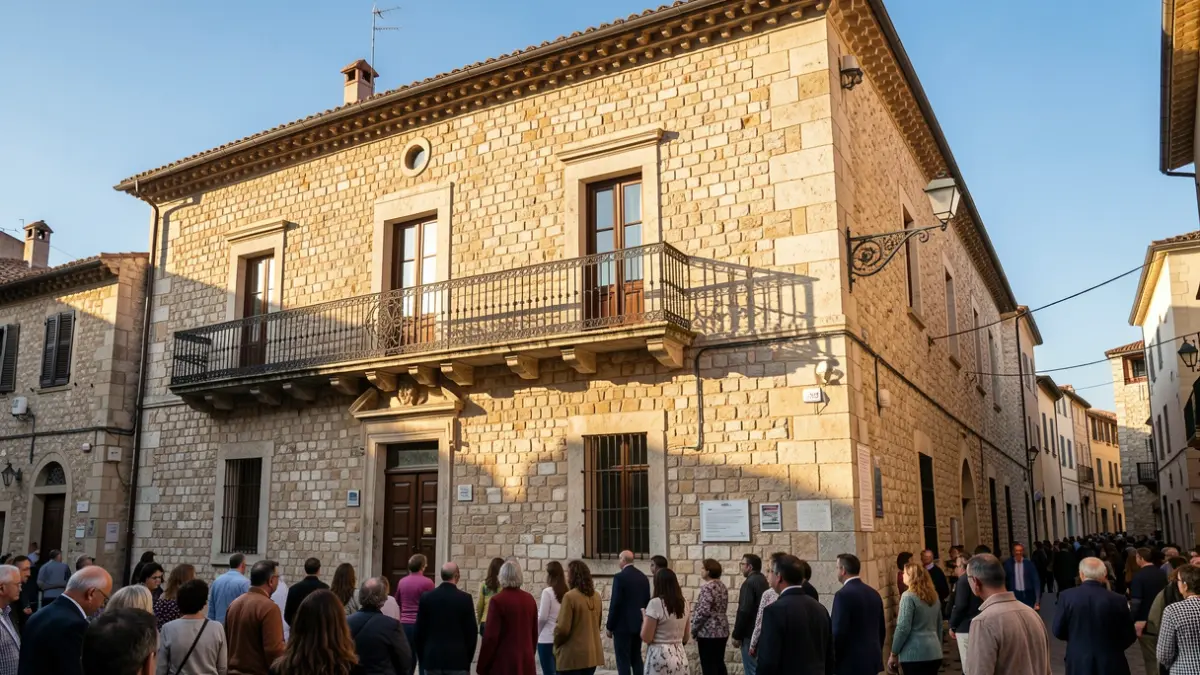
On September 25th and 26th, the municipality of Alt Maestrat was the focal point for the 'Roots of Resilience' gathering, organized by the University Extension Program of the Universitat Jaume I (PEU-UJI) and the interuniversity project RESINA. The initiative provided a space for exchanging experiences and reflecting on the transformation processes of rural territories from new social, economic, cultural, and community perspectives.
The mayor of Benassal, Èlia Garcia Colom, inaugurated the conferences alongside the Vice-Rector for Culture, Social Commitment, and Equality of the UJI, Raquel Agost. Garcia Colom advocated for moving beyond a view of the rural world solely focused on its problems, emphasizing that villages are also sources of knowledge, solidarity, and innovation. She highlighted the need for a two-way relationship between the university and municipalities, where knowledge flows in both directions.
The event underscored the importance of citizen participation, stating, 'No one knows a territory better than the people who inhabit it.' It was argued that any public policy aimed at transforming rural reality must involve its residents. During the conferences, topics such as care, proximity economy, agroecology, communal management, culture, and citizen participation were addressed.
The coordinator of the RESINA project, Xavier Ginés, presented the findings of research that identified 257 rural practices across nine pilot municipalities. The gathering highlighted numerous initiatives with limited visibility that offer responses to rural challenges. Representatives from academia, associations, local action groups, cooperatives, and local administrations participated, including Elia Calvo, councilor of the La Mata Town Council, who advocated for joint decision-making on the village model.
Culture played a significant role, with the participation of Ruth García Montañés from the young group Xalar de Benassal. The second day focused on the PEU-UJI's citizen laboratories, presenting experiences such as DescansLab from Vilafranca, Forcall Viu, the sensitive map of natural trails of Cinctorres, and Escoles de Masos de Benassal, which exemplifies the recovery of heritage and local memory.
Mayor Èlia Garcia Colom emphasized that the future of rural municipalities depends on generating opportunities, attracting talent, and ensuring services, so that 'Living in a village must be a life option with all guarantees.' The Benassal Town Council is committed to continuing to work in this direction, defending public services, the economic and social fabric, and heritage.
The conferences concluded by advocating for a perspective of the rural world as a space that generates knowledge, innovation, and its own solutions to future challenges.