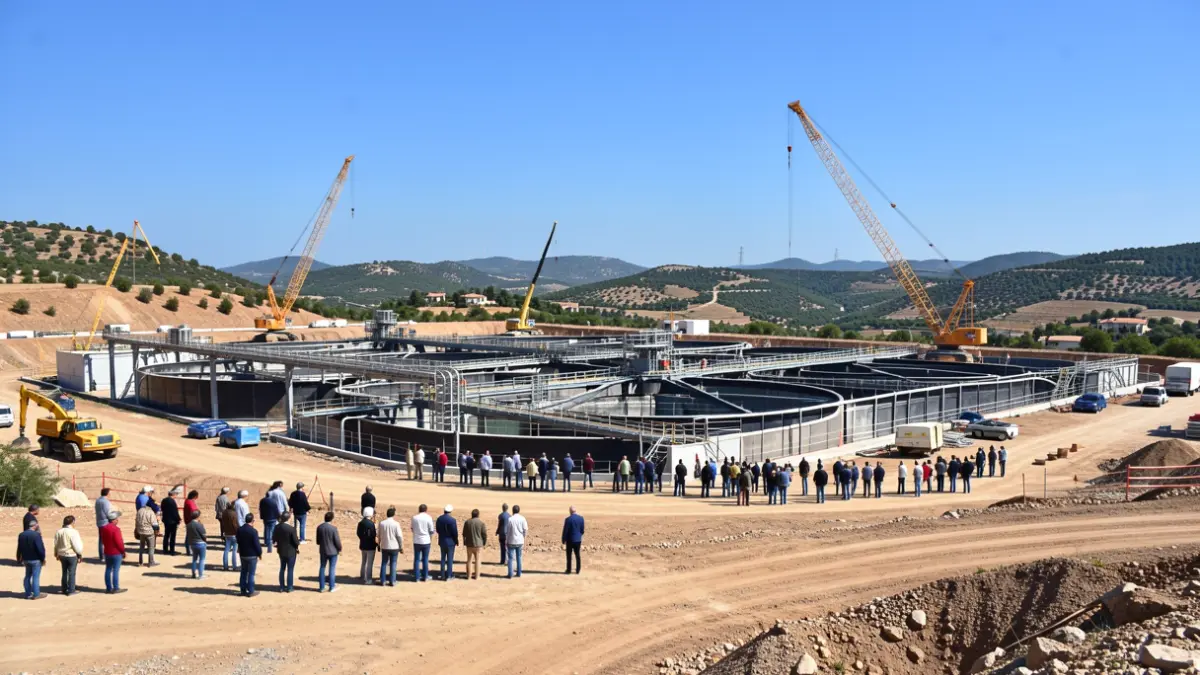
One year after the tender was activated and three legislative terms since the initial announcement, the construction for the comprehensive renovation of the Algorós wastewater treatment plant in Elche has now begun. A Temporary Union of Enterprises (UTE) comprising Drace Geocisa, Global Omnium, and Ciclagua will be responsible for carrying out an intervention that will ultimately cost 72.9 million euros, ten million less than initially planned. The project will have an execution period of three years, plus six months of testing. This investment represents the current administration's main project in the city.
This wastewater treatment plant is the major project already secured by the regional government in Elche. Other commitments, such as the tram (E-Tram) or the new healthcare building at the General Hospital, valued at around 30 million euros each, are still in the announcement or protocol phase. The plant, initiated three legislative terms ago, has overcome lengthy procedures and is now ready for the commencement of works.
Another confirmed project is the completion of the Ronda Sur (Southern Ring Road), which the Valencian Executive will also undertake. The project, estimated at 35.8 million euros, has caused delays. Currently, the work and solutions for the final section are being drafted, but it will still take a year for the tender process. The City Council has already initiated the first phase of expropriations, awaiting the second phase funded by the Generalitat. Therefore, the wastewater treatment plant, although its materialization will take three years, represents the first major millionaire commitment awarded in this legislature.
The award, which took place between July 21st and 24th, has now been made public, following the usual procedures for document submission. The winning UTE brings together specialized companies: Drace Geocisa (part of Grupo ACS), Global Omnium (integrated water cycle management with over 130 years of history), and Ciclagua (a Valencian firm specializing in the integrated water cycle).
Eleven companies submitted bids for the contract, including Acciona Agua SA and other alliances such as FCC, Dragados, Ferrovial, CHS, Eiffage Infraestructuras, and Grupo Bertolín. The site supervision contract was already awarded in March to the UTE Typsa-Inncive for 2.2 million euros. Inncive had previously designed the original project in 2022, which was initially conceived with an investment of 50 million euros. With both parts resolved, the intervention to renovate the Algorós plant and its surroundings, meeting demanding European standards, should now be ready.
The City Council had already modified the General Urban Planning Plan (PGOU) to redistribute land uses and allow the new wastewater treatment plant to integrate better into the landscape, also becoming a recreational area.
The new wastewater treatment plant (Edar) will be built in phases on the existing site to keep the facilities operational during construction. The project aims to adapt the purification process to new environmental requirements, particularly regarding the elimination of nutrients (nitrogen and phosphorus) and tertiary treatment that complies with European regulations. The two current aeration basins will be retained as a flow equalization tank.
The resulting infrastructure will reduce emissions and odors using state-of-the-art technology, making it the most modern and expensive in the Valencian Community. The current plant, forty years old, maintains a management capacity of 36,000 cubic meters per day, while the current demand is 24,000.
The design includes landscaping, palm trees, and a solar park on the roof. Future urbanization will involve widening the access road to the CV-851 highway from 12 to 18 meters to improve safety and facilitate truck access to the plant. The modification of the General Plan reallocates green areas and industrial land, compensating for the loss of green space fragments by creating new, larger areas.
Regarding archaeology, the modification establishes an action protocol with an analysis of assets within a 200-meter radius. It acknowledges the proximity of sites such as the Villa de Algorós (2nd-4th centuries AD) and the Vizcarra II settlement, maintaining subsurface control measures for the entire municipal plot and its immediate surroundings.