
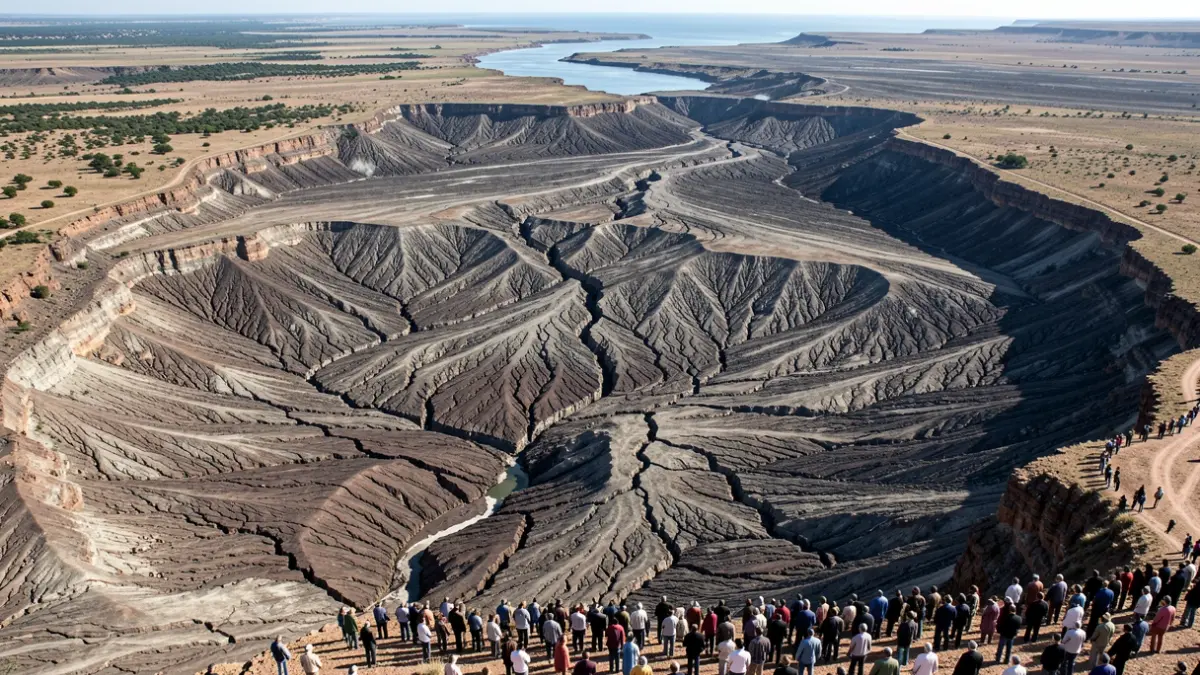
Geologists have confirmed that Africa is witnessing the early stages of a large rift formation that threatens to split the continent in two in its southern part within a few million years. This division would occur along the Kafue Rift, which is part of a line approximately 2,500 kilometers long, extending from Tanzania to Namibia.
Until now, the Kafue Rift was considered extinct. However, a scientific team points out that in recent decades it has shown signs of activity, such as minor earthquakes, an increase in underground temperature, and slight ground elevations. These indications suggest that the formation might be evolving into a new continental rift.
A recent study published in the journal Frontiers in Earth Science provides new geochemical data. According to Rūta Karolytė, a researcher at the University of Oxford, the analysis of the helium-3 to helium-4 ratio in samples of thermal water and gases from Zambia indicates a connection with the Earth's mantle. This strengthens the idea of rift activity in the region.
These findings are crucial for understanding how tectonic plate boundaries begin, a process more subtle than that of mature boundaries. If the Kafue Rift is a nascent plate boundary, it offers a unique opportunity to study its birth before other geological processes modify it.
The process of forming a new plate boundary could take between 2 and 20 million years. In the best-case scenario, the separation of southern Africa could occur in a couple of million years, preceded by an increase in seismic activity and volcanic activity, the formation of lakes, and ultimately, a new sea.