Six professionals in research and entrepreneurship shared their experiences at the UV Science Park, demonstrating how science can address real-world challenges. The stories ranged from digital accessibility and mental health to crop protection and medical diagnostics.
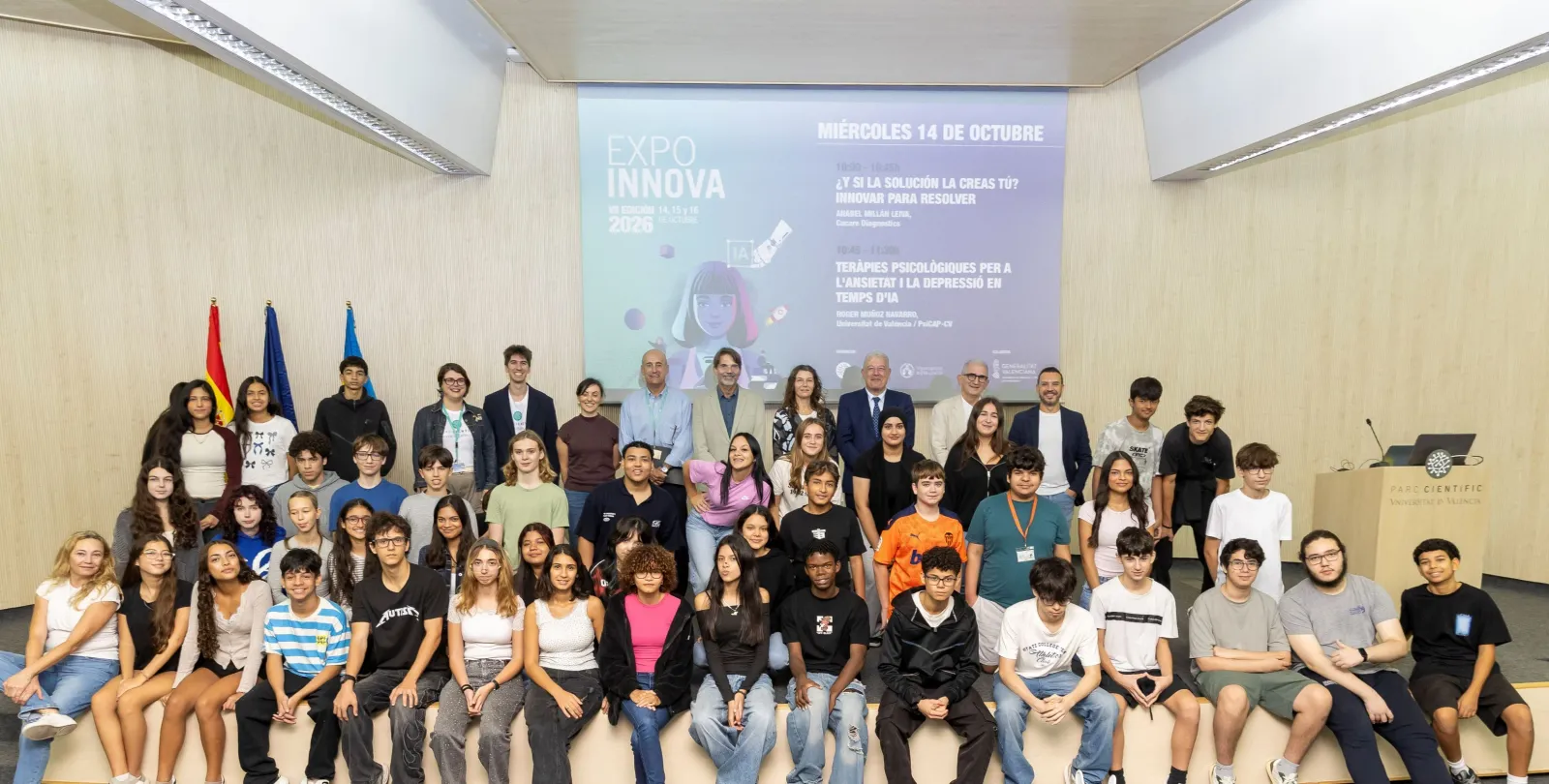
The event saw participation from nearly 400 students in person at the Marie Curie Auditorium, with an additional 200 following sessions online. Expoinnova's primary goal is to bring scientific knowledge closer to pre-university students, showcase its practical applications, and offer insights into educational and professional opportunities in research, technology, and entrepreneurship.
Collaboration between the PCUV, the University of Valencia, and the educational administration was key to facilitating this connection. Over three days, lectures and Q&A sessions were held, featuring representatives such as Pedro Carrasco, director of the UV Science Park; José María Montiel, Vice-Rector for Innovation and Transfer at the University of Valencia; and Daniel McEvoy Bravo, regional secretary of Education.
Anabel Millán Leiva, co-founder of Cucare Diagnostics, explained how research on bee diseases can lead to a business venture, emphasizing the importance of listening to sector needs to transform knowledge into practical solutions.
Roger Muñoz Navarro, a professor at the University of Valencia, focused his talk on mental health and the role of artificial intelligence (AI) in improving the detection and monitoring of disorders, while also cautioning about its limitations and the need for professional supervision.
Nerea Panadero, co-founder of AIntegra, shared how she began developing a technological tool to enhance the digital autonomy of visually impaired individuals, inspired by her father's challenges. Her experience highlighted that entrepreneurship in science involves observing and solving everyday problems.
Joan Vila Francés, delegate for AI at the University of Valencia, presented university projects applying AI in sectors like medicine, tourism, and public administration, including a system for analyzing Doppler ultrasounds in collaboration with the La Fe Hospital.
Josemaría Delgado Martín, founder of Modoru Biotech, illustrated how a scientific career can evolve into agricultural biotechnology, developing RNA-based solutions to protect crops, and encouraged students to explore non-linear career paths.
Anabel Forte, a Statistics professor at the University of Valencia, concluded the program by discussing the mathematical foundations of AI, its applications, and challenges like data bias, stressing the importance of critical thinking and human responsibility.
In addition to the lectures, the interactive activity «Escape Road: searching for Nobel and non-Nobel scientists» was held, guided by Bibiana Martínez Torrecilla, to highlight the contributions of women researchers.
The event underscored the importance of connecting classroom knowledge with real-world applications and accessible professional role models, inspiring students to consider new academic and career paths.