
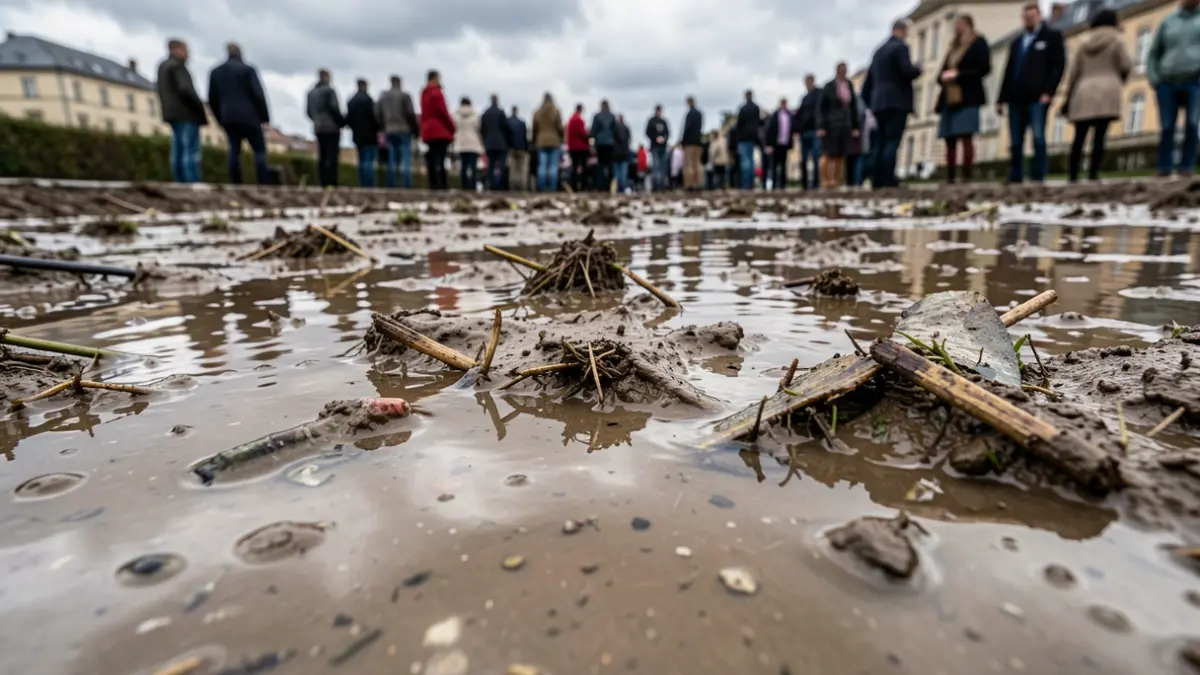
The floods caused by the DANA in October 2024 in the province of Valencia left significant environmental consequences and affected homes. Two years later, research is providing a better understanding of some of these effects and advancing the development of tools for the recovery of damaged areas.
The Institute of Agrochemistry and Food Technology (IATA-CSIC) has participated in studies on the presence of contaminants in water, sediments, and dust. Additionally, it coordinates the European project FLOWSAFE, which will develop solutions for restoring degraded ecosystems, and has collaborated with other CSIC centers on a patented antifungal formulation to eliminate mold on surfaces affected by humidity.
The floods caused the collapse of treatment plants and sewage networks in the area around l’Albufera, releasing large amounts of untreated wastewater. A study by CEBAS-CSIC and IATA-CSIC, with participation from ICMAN-CSIC and IDAEA-CSIC, assessed the water and sediment quality of the Natural Park of l’Albufera and the Poyo and Picassent ravines.
Microbiological analyses detected an increase in indicators of fecal contamination, such as Escherichia coli, and enteric viruses. "These results confirmed a significant input of wastewater after the floods. Although contamination levels decreased over time, several indicators remained higher than normal six months later," explains Ana Allende, a researcher at CEBAS-CSIC.
General chemical contamination was found at low to moderate levels, although specific points with higher contaminant accumulation were identified, particularly in areas influenced by urban and agricultural activity along the Poyo stream. Recovery was uneven, as sediments retained localized contamination hotspots that could be mobilized again.
The work, published in the journal Journal of Hazardous Materials, demonstrates that Mediterranean wetlands like l’Albufera are vulnerable to extreme weather events. The authors highlight the need to improve the resilience of sanitation and flood management infrastructure, and emphasize that analyzing only the water is insufficient to assess an ecosystem's recovery.
Another study by IATA-CSIC analyzed sediment and dust samples. Results reveal that mud contained more potentially pathogenic microorganisms like Salmonella or E. coli, while dust had double the microplastics per gram compared to sediments. Dust also contained smaller particles, increasing its potential for airborne dispersal.
"Floods not only displace contaminants but can also redistribute them among different environmental compartments, creating exposure pathways for people and ecosystems," remarks María José Fabra, a researcher at IATA-CSIC.
To address the proliferation of mold in humidity-affected buildings, researchers from IATA-CSIC, CENIM-CSIC, and IETcc-CSIC have developed a patented antifungal formulation. The treatment combines alcohols and an antimicrobial compound, is easy to apply, and costs less than some commercial alternatives.
The product's effectiveness was evaluated against fifteen species of filamentous fungi isolated from flood-affected homes. Tests showed the formulation completely inhibited spore formation and significantly reduced their development. "Having effective and long-lasting treatments facilitates the safe recovery of affected homes," notes Ana Rosa Ballester, a researcher at IATA-CSIC.
The European project FLOWSAFE, coordinated by IATA-CSIC, will bring together 13 partners from six countries until 2030 to develop a modular platform combining bioremediation techniques, nature-based solutions, smart sensors, and artificial intelligence to restore ecosystems affected by complex contaminants.
The project will act on both sediments and the water column, focusing on metals, microplastics, pharmaceuticals, and pesticides. "Our goal is to develop tools that allow for the restoration of these areas more quickly, effectively, and adapted to each territory," explains Marta Arroyo, a researcher at IATA-CSIC and project coordinator.
FLOWSAFE will validate the technologies in three European areas affected by floods: l’Albufera de València, the Kaczawa River sub-basin (Poland), and the Meža River sub-basin (Slovenia). The project will also incorporate Earth observation systems and sensors for real-time contamination monitoring.