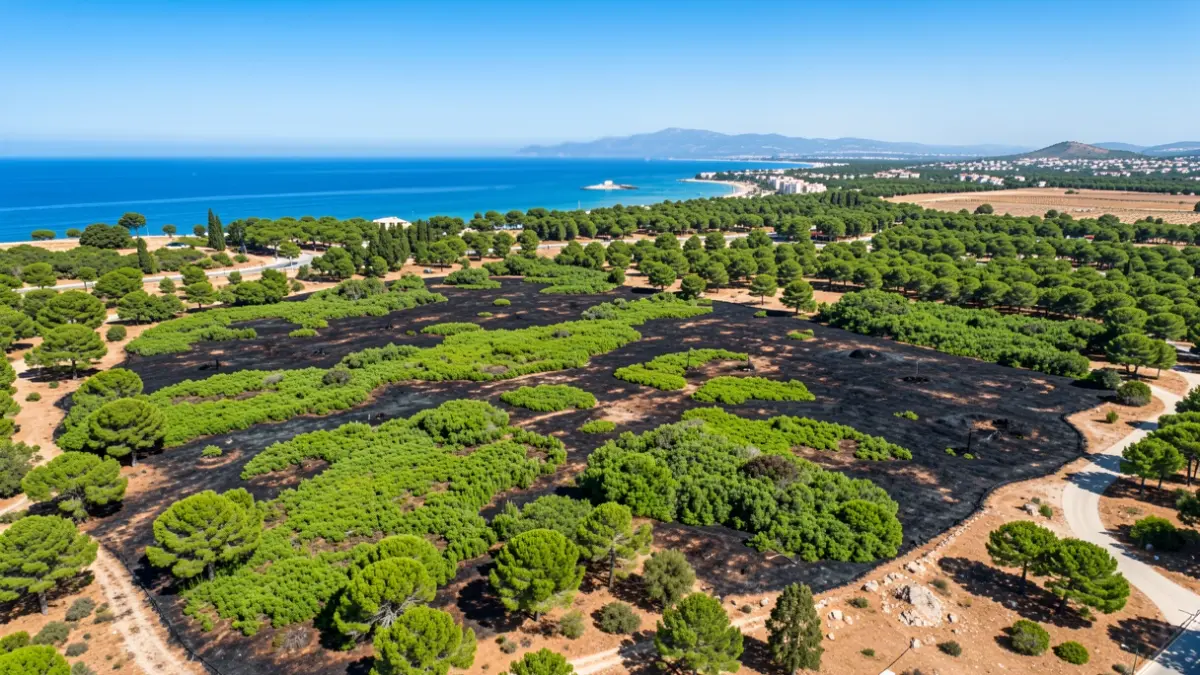
The Ministry of Environment, together with the Valencia City Council, has announced the imminent start of the first phase of regeneration for the natural park of El Saler. These actions, set to begin in the coming weeks, have a budget of 150,000 euros to tackle the consequences of the fire that occurred this summer.
Following the reception of the report from the Mediterranean Environmental Studies Centre (CEAM), detailing the impact and necessary measures for recovering the 37 burnt hectares, the Generalitat will proceed with removing trees at risk of falling and restoring paths. The City Council, in turn, will focus on eliminating invasive species hindering the pine forest's recovery and will restrict access to certain affected areas.
The Mayoress of Valencia, María José Catalá, and the Third Vice President and Minister of Environment, Vicente Martínez Mus, made this announcement after a meeting to analyze the conclusions of the CEAM report. Martínez Mus highlighted the CEAM's role as a reference center for the rapid recovery of the environment.
Over the next three months, the Generalitat will carry out emergency actions to ensure the area's safety. These include removing burnt trees posing a falling risk, improving the accessibility of forest tracks, delineating sensitive zones, replacing safety elements, and managing plant debris. The minister assured that permits would be processed swiftly to commence the work, subject to the corresponding administrative procedures.
Subsequently, the regeneration's progress will be monitored for a period of three to five years. The CEAM report classifies the impact on trees as "high or medium," while shrubs and low-lying plants are already showing signs of recovery. However, the impact on the tree-covered area has been "severe," although the erosion risk is low.
The report also indicates that, since the 1980s, the cumulative area affected by fires in La Devesa amounts to 149 hectares (20.3% of the total). Considering fires since 2017, the figure reaches 360 fires and 219 hectares burnt (period 1968-2025), representing 30% of La Devesa. The latest fire raises the percentage to 34.5%, primarily affecting adult pine specimens aged between 45 and 50 years.
Mayoress Catalá reiterated the City Council's commitment to regeneration, including the removal of invasive species and access restrictions to aid the pine forest's recovery. Firefighting cannons will also be installed, and CEAM recommendations will be followed. Catalá emphasized that the fire was intentional and called for harsher penalties for arsonists, noting that over 60% of fires in La Devesa since 1993 have been deliberate.