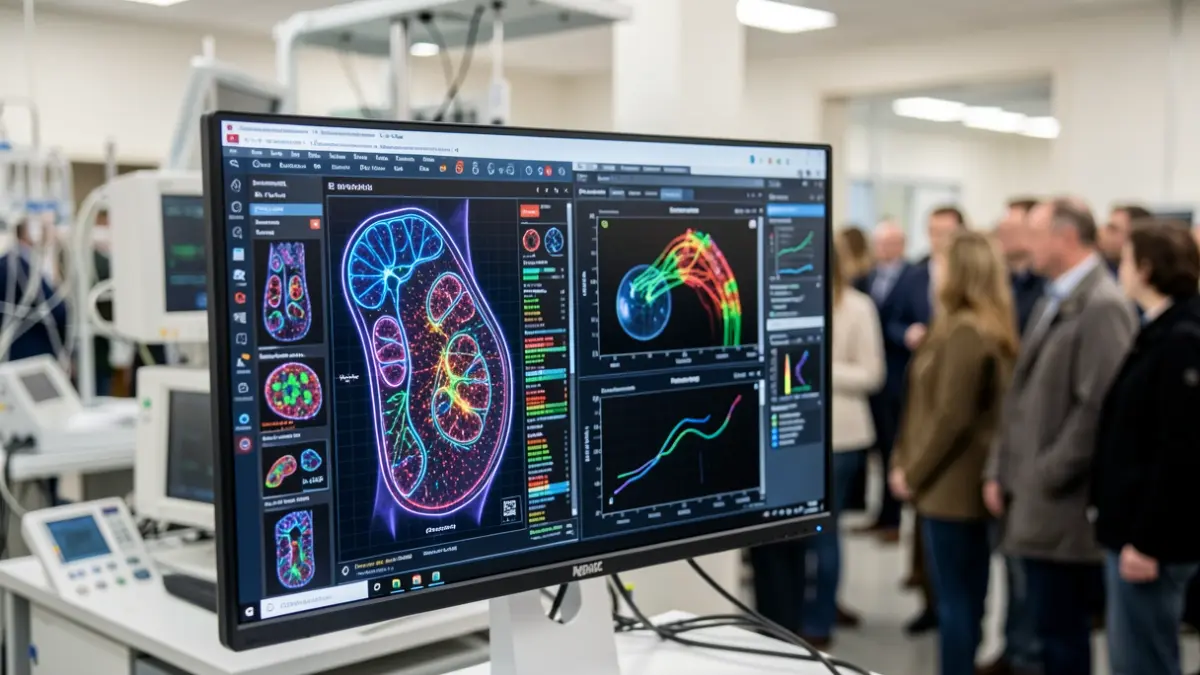
The project, named MEL-IA, has achieved an overall accuracy of 86% in tests conducted with a dataset used for its training and validation. The results of this research have been recently published in the scientific journal Journal of Medical Systems.
The tool can classify five types of lesions: melanoma, nevus, basal cell carcinoma, actinic keratosis, and benign keratosis. Its performance has been evaluated in a testing environment using anonymized dermatological images, outside of the clinical workflow and without direct patient intervention.
This research originated as a final degree project by a student of Biomedical Engineering from the University of Alicante, who completed their internship at the hospital's IT Service. Starting from a pre-existing AI algorithm and an application for capturing images and clinical information, the hospital team and the student adapted the solution to the security, integration, and organizational requirements of a hospital environment.
José María Salinas, head of the IT Service at Sant Joan d’Alacant Hospital, explains, “The idea was to apply our experience in healthcare information systems and completely redesign the solution, with the student’s input, to ensure it met all security and standards requirements and could be integrated into a clinical workflow.”
To test the algorithm, a dataset of anonymized dermatological images from the Alicante-Sant Joan Health Department was created. These images were used to train the model and conduct a proof-of-concept test, with results reviewed and validated by the hospital's Dermatology Service. “We ended up with a robust solution, technologically prepared for integration into any clinical system, and the proof-of-concept tests were satisfactory,” notes Salinas.
The experience gained in this project has also served as a reference for future teledermatology solutions and has allowed the application of university knowledge to a practical case in healthcare information systems.