
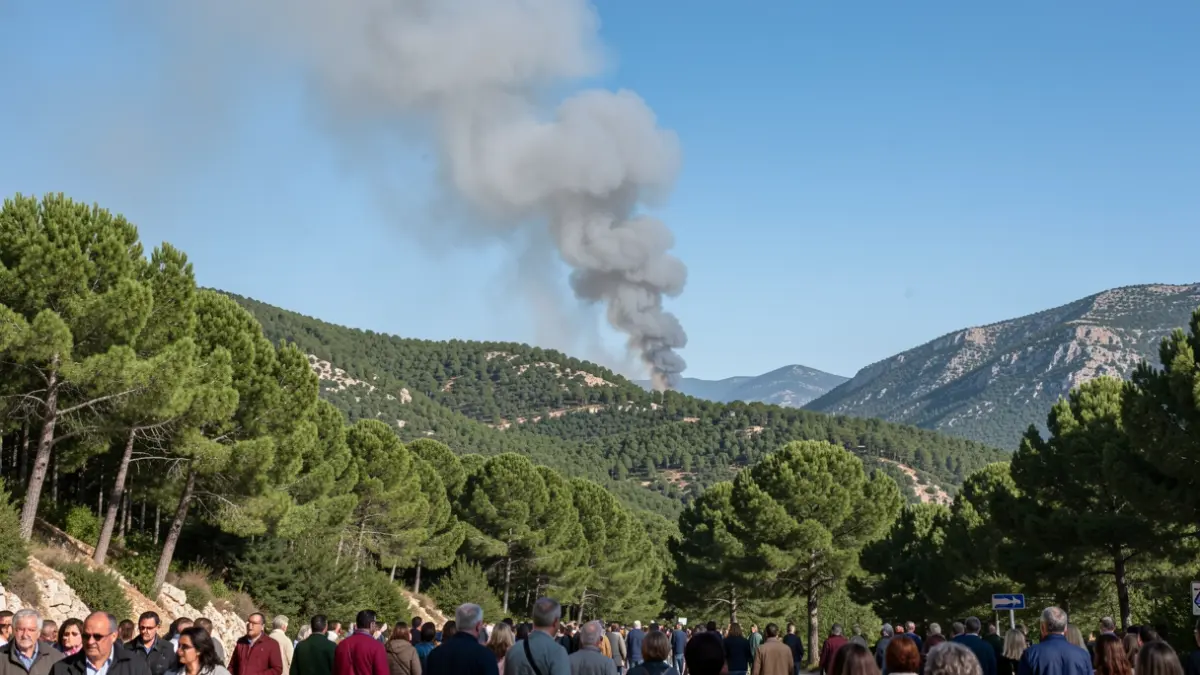
The Sierra Calderona, one of the main green lungs of the Valencian Community, has historically suffered numerous fires and outbreaks. These circumstances have left a scar of over 12,000 hectares burned in its forest heart, recurrently endangering municipalities such as Gátova, Olocau, Marines, Llíria, Segorbe, and Altura.
The natural park and its surroundings have seen their forest mass devoured by a combination of adverse weather phenomena, human imprudence, and intentional episodes. The nineties were particularly critical, with a devastating fire in August 1994 that ravaged nearly 10,000 hectares. This fire, originating in the province of Valencia, primarily affected the province of Castellón, with 5,050 hectares lost. Other notable fires from that era include those in Marines and Olocau (1993) and Estivella (1991).
More recently, the summer of 2004 saw a severe fire in Serra, Náquera, and Segart, which destroyed 720 hectares of mature forest. In June 2017, a latent lightning strike caused a fire in Gátova that burned over 1,400 hectares, many within the protected area, and whose smoke reached as far as Mallorca.
In addition to internal fires, the Calderona faces the constant threat of large bordering fires. The terrible fire of Andilla in 2012 affected nearly 25,000 hectares in the Serranos and Alto Palancia regions. Subsequently, the fire in Bejís in 2022 ravaged 19,000 hectares. Both fires, totaling nearly 44,000 hectares, reached the municipal terms of Altura and Segorbe, very close to the natural park.
Despite the rapid response of emergency teams in many cases, the vulnerability of the Calderona remains at its peak. The accumulation of biomass, prolonged drought, and territorial pressure keep this protected space in a constant state of risk, especially when temperatures soar.