
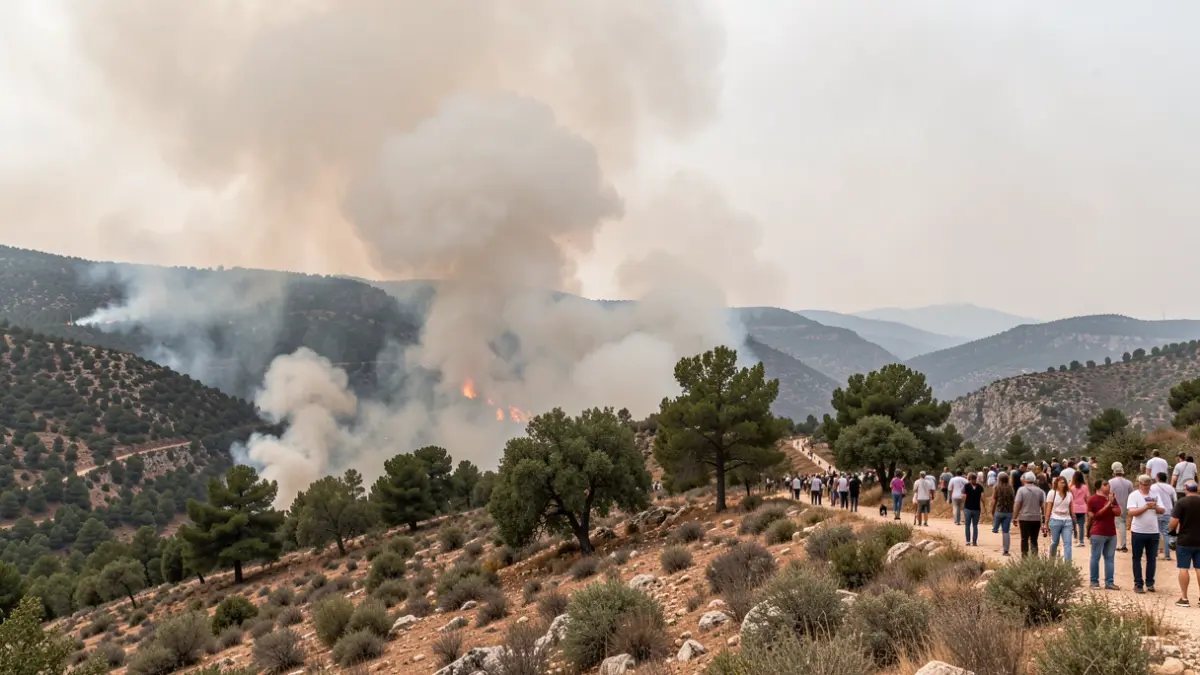
The wildfire declared in the Serra Calderona has seen the burned area multiply fivefold in just a few hours, growing from 130 hectares at dawn to a much larger area as winds and temperatures shifted during the central hours of the day. This evolution is explained not only by recent meteorological conditions but also by medium and long-term phenomena such as persistent rainfall deficit and high availability of dry vegetation acting as fuel.
From the State Meteorological Agency (Aemet), its spokesperson for the Valencian Community, José Ángel Núñez, explains that the key components of a wildfire are meteorology, topography, and fuel. The topography of the Serra Calderona, with its mountains, valleys, and narrow ravines, is a fixed factor that favors adverse fires. This year, fuel availability is particularly high, not only in the Valencian Community but in many large fires across Spain.
Regarding meteorology, automatic stations at Masía de la Hoya (in Segorbe) and Gátova record extreme drought over the last 100 days, with record temperatures. The last day with significant rain was May 18th, with scarce amounts. The rainfall deficit since then approaches 90%. Paradoxically, a wet end to winter, with notable rains in March, favored vegetation growth, which is now dry and conducive to fire spread.
Temperatures have been record-breaking, especially in July, which was the hottest month in the historical series at Masía de la Hoya. June was the second hottest, and the first half of August also registered unprecedented temperatures. This combination of persistent heat and drought stressing vegetation, along with complex topography, makes the fire particularly aggressive and fast-spreading.
“"Climate change does not ignite the final spark that generates the fire, but it does prepare the ground so that, if a fire occurs, it is more aggressive and spreads rapidly, sometimes beyond the capacity to extinguish it."
Núñez insists that the current extreme climatic conditions, such as persistent heatwaves and prolonged droughts, have not been recorded before. These conditions favor convective fire behaviors, which hinder extinguishment and generate secondary ignitions due to the rapid advance of the fire.